
Listening to the signal
that's already there.
The wireless world permeates every site on Earth — civil broadcast, telecom, satellite. Liminal Sensing turns that ambient field into a perimeter sensor.
A well-understood physics, applied at a new scale.
Every wireless signal propagates through space. As it travels from transmitter to receiver, anything in its path subtly alters its arrival — its amplitude, its phase, its angle. Bodies absorb, vehicles reflect, drones scatter. The receiver sees the change.
This is not a new idea. The same physics is widely used — in telecom link monitoring, indoor security sensing, and even medical imaging.
What is new is the practical application of this physics at the scale of a single industrial asset — assembled from mature components, deployed just-in-time, for passive outdoor monitoring.
Eclipse the sun and the sky goes dim. Walk through a wireless field and the signal changes. We are watching for the dim.
A distributed receiver mesh, deployed in a day.
Ambient radio sources
Rather than emitting our own signal, we use what is already in the air. Broadcast television. FM and DAB radio. GSM, LTE, and 5G base stations. Satellite downlinks. Wi-Fi. The richness of the modern RF environment is our resource.
Receivers
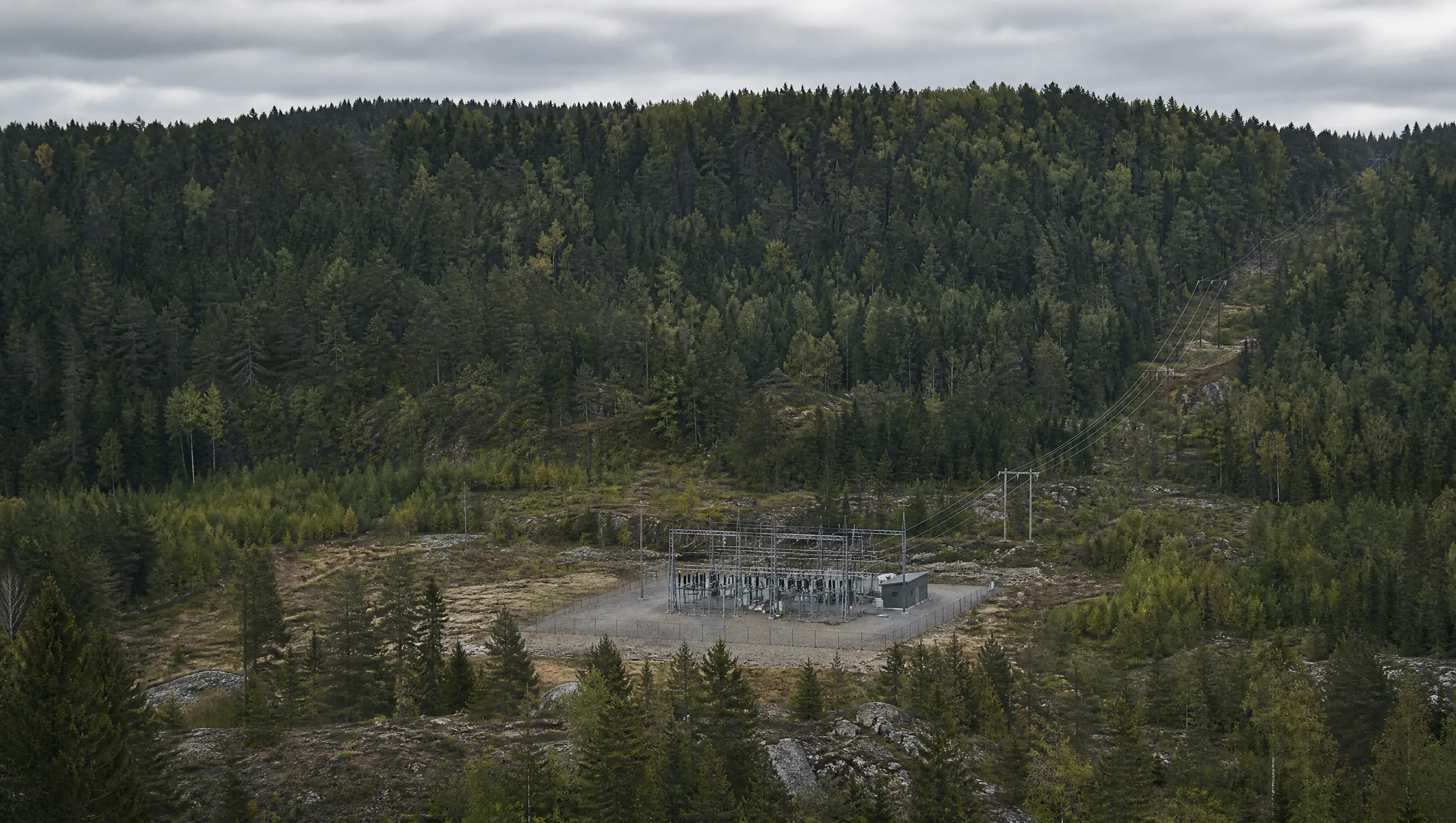
A small number of receivers are placed strategically around the perimeter of the asset. Each is autonomous, low-power, and runs on a steady power source using an on-board battery. Each measures the wireless channel between ambient radio sources and itself, continuously, with no transmission of its own.
Edge processing
An on-site edge processor establishes a baseline of the ambient RF environment over a calibration window — typically days, sometimes weeks, depending on the site. From that baseline, real-time anomaly detection identifies disturbances. A classification model assigns each anomaly a probable cause: human, vehicle, drone, animal, or environmental noise.
Alerts and integration
When an anomaly is found suspicious, the system issues an alert. Optional camera and motion sensors verify and provide evidence for incident response. Alerts are delivered into existing VMS, SOC and alarm systems via standard protocols.
Today, and on the path.
Operational today
- Human intrusion across a defined perimeter
- Vehicle approach inside or adjacent to the protected zone
- Anomalous movement patterns inside the protected zone (loitering, repeated transit)
In active development
- Low-altitude drone approach
- Differentiation between drone classes
- Vehicle-type classification (light vehicle vs heavy machinery vs service vehicle)
- Integration with insurance reporting and underwriting workflows
Our development roadmap is informed directly by customer pilots. The capabilities we prioritise are the capabilities our pilot partners need.
We complement, not replace.
Liminal Sensing is one layer in a multi-modal security stack. We do not overrule cameras, fences, fibre PIDS, active radar or guarding services. We add a sensing modality that those alternatives cannot provide at our cost and deployment economics.
vs Cameras
Cameras see line-of-sight, struggle in darkness, weather and vegetation, and generate high false-alarm rates. Always-on video also raises privacy and GDPR concerns. We see volumetric, all-weather, and cue cameras to slew-to-event.
vs Fibre PIDS
Fibre requires continuous installation — trenching, conduits, kilometres of cable. We deploy as a small set of point sensors in a day. Better fit for distributed and unfenced assets.
vs Active radar
Active radar emits a signal that adversaries can detect, attribute and avoid. We only listen, and are not detectable through transmission. We also operate at a fraction of the unit cost.
vs Fences and guarding
Fences are slow to build and easy to cut. Guarding does not scale to distributed assets. We are designed for sites that are too remote, too distributed, or too transient for either.
Integration model
Alerts and metadata stream into your existing VMS, SOC or alarm-receiving centre via standard protocols (SAPIENT, ONVIF, MQTT, REST). We are designed to be fully integrated into your operator workflow.
Partnership posture
We work alongside cameras (Axis, Bosch), VMS platforms (Milestone, Genetec), guarding services and counter-UAS primes. We are a sensor layer — not a system integrator.
Built on six years of applied research.
Our work is grounded in the research base of FADEC, the parent applied-research company, and in long-standing collaboration with Chalmers University of Technology and Uppsala University's Ångström Laboratory.
Two of our founders are senior academic researchers in applied mathematics and RF engineering respectively. Our co-founders' published work spans signal processing, machine learning, microwave systems and antenna design — and predates the company's founding by nearly two decades.
IP status
Three IP filings are currently pending at Sweden's PRV (Patent and Registration Office), covering distinct claims relating to our sensing architecture and detection methods. A more detailed technical and IP briefing is available on request and under NDA.
Funding & partnership
The development of our technology is supported by a multi-year European Innovation Council (EIC) project running 2025–2028. The EIC project funds field-validation and system maturation of our core technology.
Want to go deeper?
We share more technical detail under NDA with serious counterparties — operators evaluating us for deployment, primes evaluating us for integration, and investors evaluating us for participation.
team@liminalsensing.com